
The short answer
A ductless mini-split is a heat pump that heats and cools individual rooms without ducts, which makes it a strong option for additions, garages and older San Jose homes. We size each indoor head to the room, plan the line set route, and explain repair or replacement choices before any work begins.
A ductless mini-split puts heating and cooling exactly where a room needs it, with no ductwork in the walls or attic. For a lot of South Bay houses that is the simplest fix for a stubborn problem: the converted garage that never gets comfortable, the upstairs bedroom that bakes every August, or the older ranch home that was built with a wall heater and nothing else. ClearSky Heating & Cooling plans and installs mini-split systems for homeowners in San Jose and the surrounding cities, starting with a careful look at how your house actually behaves through the seasons. Below you will find how to tell whether ductless is a good match, what our technicians measure before recommending equipment, how an existing mini-split can be repaired or replaced, which factors move the project cost, and what installation day looks like from start to finish.
Clues that a mini-split belongs in your home
Ductless equipment solves a specific set of problems. It rarely makes sense to rip out a healthy central system, but it often beats the alternatives when a space was never connected to ducts in the first place or when stretching existing ducts would mean opening ceilings. Here are the situations where homeowners around the valley most often end up choosing it.
The Santa Clara Valley has dry summers and mild, damp winters, and the inland and southern parts of the valley run noticeably hotter in summer than neighborhoods closer to the Bay. That spread means one room facing west can need far more cooling than the rest of the house, and a zoned ductless head handles that imbalance well.
- A garage conversion, accessory dwelling unit or room addition with no supply or return ducts.
- Window units or portable air conditioners that are loud, inefficient and block the view.
- An older home heated by a wall furnace or baseboard heaters, with no ducts and no room for them.
- One floor that stays several degrees warmer or cooler than the others no matter how the thermostat is set.
- A home office or nursery where you want separate control instead of conditioning the whole house.
- Plans to move away from gas heat over time and add a heat pump room by room.
What our technician evaluates before quoting
A mini-split that is too large for a room short-cycles, leaves humidity behind and wastes energy; one that is too small runs flat out on the hottest afternoons and still falls behind. So the first visit is mostly measuring and asking questions. We look at square footage, ceiling height, window area and which direction the glass faces, insulation in the walls and attic, and how many people use the room and when.
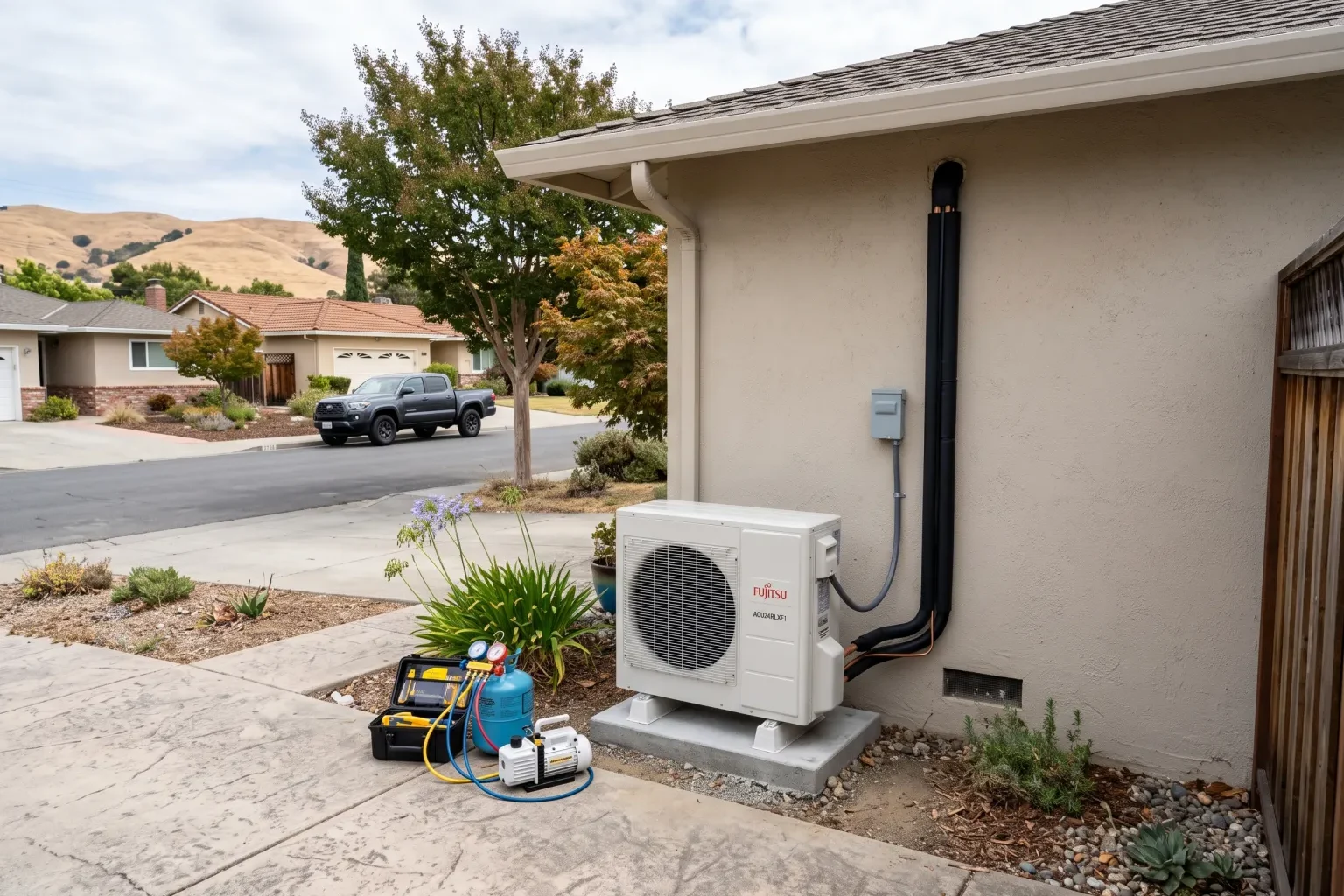
Next comes the physical layout. Every indoor head connects to the outdoor condenser through a refrigerant line set, a condensate drain and a power and communication cable. We trace a route for those lines that keeps them short and neat, find a level spot for the outdoor unit with clearance for airflow and service, and check whether your electrical panel has capacity for a new dedicated circuit.
We also talk through the style of indoor unit. High-wall heads are the most common, but floor consoles suit rooms with low windows, and slim ceiling cassettes or concealed ducted units work when you would rather not see equipment on the wall at all.
Repairing an existing mini-split versus replacing it
Many San Jose homes already have a ductless system that was installed some time ago. When one stops cooling or heating, the cause is often modest: a clogged filter or blower wheel, a blocked condensate line dripping water down the wall, a failed sensor, or a small refrigerant leak at a flare fitting. Those problems are worth fixing, and a cleaning alone can restore a surprising amount of capacity.
Replacement becomes the better path when the compressor or inverter board has failed on an older outdoor unit, when the system uses an obsolete refrigerant that is becoming hard to source, or when repeated leaks point to corroded coils. In some cases we can reuse a properly sized and flushed line set, which simplifies the work. We explain what we found, show you the component in question when we can, and lay out both choices so you can decide with the facts in front of you.
What shapes the cost of a ductless project
We give a written quote after the site visit rather than a ballpark over the phone, because the variables below differ so much from one house to the next.
- Number of indoor zones and whether they share one multi-zone outdoor unit or use separate single-zone systems.
- Indoor unit style, since ceiling cassettes and concealed units take more labor than wall-mounted heads.
- Length and difficulty of the line set route, including runs through attics, crawlspaces or multiple floors.
- Electrical work such as a new breaker, a disconnect or an upgrade to an undersized panel.
- Equipment efficiency level and whether you want models rated for strong heating output on cold mornings.
- Wall penetrations, line covers, condensate pumps and any patching or finish work around the install.
- Local permit requirements and inspection scheduling with your city.
How installation day unfolds
Once you approve the plan, we schedule a date and confirm the location of every head and the outdoor unit. On the day itself, the crew protects floors and furniture, mounts the indoor brackets level, drills a small sleeve through the wall for the lines and sets the outdoor unit on a pad or wall bracket.
After the lines are connected, we pressure test the refrigerant circuit with nitrogen and pull a deep vacuum to remove moisture and air before releasing refrigerant. That step is easy to skip and is one of the main reasons poorly installed systems fail early. We then power up, check temperatures at each head, confirm the drain flows, and walk you through the remote or app, filter cleaning and the settings that keep the system efficient.
Most single-zone jobs wrap up within a day; multi-zone systems or homes needing electrical upgrades can take longer, and we tell you that up front. If the city requires an inspection, we coordinate it.
Incentives and Bay Area rules worth knowing
A mini-split is a heat pump, so it can be part of a gradual move away from gas heat. Bay Area homeowners can check BayREN and their local clean energy provider for current heat pump and electrification incentives. Amounts and availability change by funding cycle, so we confirm the current offer before we mention it in a quote. The federal 25C home improvement credit covered qualifying heat pumps placed in service before December 31, 2025, and it is not available for new installations after that date.